Details
Factory Sells Best Quality Fenthion 55-38-9 with steady supply
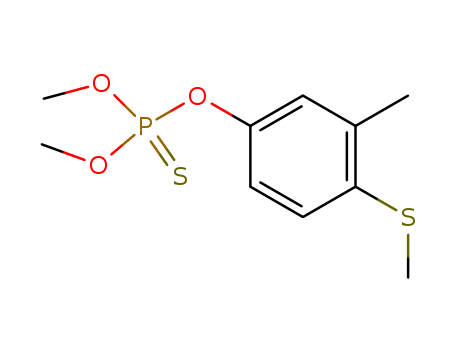
- Molecular Formula:C10H15O3PS2
- Molecular Weight:278.333
- Appearance/Colour:yellow brown oily liquid
- Vapor Pressure:4.61E-05mmHg at 25°C
- Melting Point:7.5 °C
- Refractive Index:1.558
- Boiling Point:330 °C at 760 mmHg
- Flash Point:153.4 °C
- PSA:94.89000
- Density:1.25 g/cm3
- LogP:4.26360
Fenthion(Cas 55-38-9) Usage
|
Mode of action |
Fenthion belongs to one of a class of insecticides referred to as organophosphates[1,9]. These chemicals act by interfering with the activities of cholinesterase, an esterase that lyses choline-based esters, several of which serve as neurotransmitters. Thus, it is either of two enzymes that catalyze the hydrolysis of these cholinergic neurotransmitters, such as breaking acetylcholine into choline and acetic acid. These reactions are necessary to allow a cholinergic neuron to return to its resting state after activation. Therefore, it is essential for the proper working of the nervous systems of both humans and insects[10, 11]. |
|
Warning and Risk |
Fenthion can provide both acute toxicity and chronic toxicity. Acute toxicity[12] It is moderately toxic if ingested, inhaled, or absorbed through the skin. It affects the central nervous, cardiovascular, and respiratory systems, and may irritate eyes and mucous membranes. When inhaled, the first effects may include bloody or runny nose, coughing, chest discomfort, difficult or short breath, and wheezing due to constriction or excess fluid in the bronchial tubes. Skin contact with organophosphates may cause localized sweating and involuntary muscle contractions. Eye contact will cause bleeding, tears, pupil constriction, pain, and blurred vision. Symptoms of acute exposure to organophosphate or cholinesterase-inhibiting compounds may also include the following: dizziness, tremor, nausea, abdominal cramps, sweating, blurred vision, headache, numbness, tingling sensations, incoordination, difficulty breathing or respiratory depression, and slow heartbeat. Very high doses may result in unconsciousness, incontinence, and convulsions or fatality[12]. Chronic toxicity Carcinogenic effectsThe National Cancer Institute performed carcinogenicity tests on fenthion that indicated that this insecticide might be a carcinogen in male mice. However, no carcinogenic effects were observed in other two-year feeding studies of rats and mice[13]. Reproductive effects-Single injections of 40 or 80 mg/kg of fenthion into the abdominal cavities of pregnant female mice caused poisoning in the developing fetuses, particularly when administered on days 10 through 12 of gestation. There were significantly more abnormalities in the offspring of female mice that had received 40 mg/kg on days 8 or 10 of pregnancy[14, 15]. Teratogenicity effects-Some reduction in fetal weight occurred, but no defects were found in mice that were given intraperitoneal doses of up to 80 mg/kg of fenthion in single day or 3-day periods during the period of gestation in which organs are formed[16]. |
|
Reactivity Profile |
Fenthion may react with strong reducing agents such as hydrides to generate highly toxic and flammable phosphine gas. Partial oxidation by oxidizing agents may result in the release of toxic phosphorus oxides. |
|
Hazard |
Toxic by ingestion, inhalation, and skin absorption; use may be restricted, cholinesterase inhibitor. Toxic by skin absorption; questionable carcinogen. |
|
Health Hazard |
Fenthion is moderately toxic to mammals, and highly toxic to birds. Exposures to fenthion cause poisoning with symptoms among occupational workers as observed with organophosphate pesticide-induced toxicity. These include, but are not limited to, numbness, tingling sensations, incoordination, headache, dizziness, tremor, nausea, abdominal cramps, sweating, blurred vision, diffi culty breathing or respiratory depression, and slow heart beat. Very high doses may result in unconsciousness, incontinence, and convulsions or fatality. Reports have indicated that exposures to fenthion cause adverse effects on the central and peripheral nervous systems, and the heart of exposed workers. |
|
Fire Hazard |
Fenthion is probably combustible. |
|
Trade name |
B 29493?; BACID?; BAY 29493?; BAYCID?; BAYER 29493?; BAYER 9007?; BAYER S-1752?; BAYTEX?; ENTEX?; LEBAYCID?; MPP?; MPP (pesticide) OMS 2?; PHENTHION?; PILARTEX?; QUELETOX?; S 1752?; SPOTTON?; SULFIDOPHOS?; TALODEX?; TIGUVON? |
|
Potential Exposure |
A potential danger to those involved in the manufacture, formulation, or application of this agricultural chemical and pesticide; insecticide |
|
Environmental Fate |
Biological. From the first-order biotic and abiotic rate constants of fenthion in estuarine water and sediment/water systems, the estimated biodegradation half-lives were 22.4 and 3.9–14.5 days, respectively (Walker et al., 1988).Surface Water. In estuarine water, the half-life of fenthion was 4.6 days (Lacorte et al., 1995). Plant. In plants, fenthion oxidizes to the mesulfenfos and sulfone which further degrades to the sulfone phosphate before undergoing hydrolysis (Hartley and Kidd, 1987).Photolytic. Fenthion was oxidized to the corresponding sulfoxide and trace amounts (<5% yield) of sulfone when sorbed on soil and exposed to sunlight. The photosensitized oxidation was probably due to the presence of singlet oxygen. The degradation rate was higher in soils containing the lowest organic carbon (Gohre and Miller, 1986).Chemical/Physical. Stable at temperatures below 210°C (Worthing and Hance, 1991). Emits very toxic fumes of phosphorus and sulfur oxides when heated to decomposition (Sax and Lewis, 1987; Lewis, 1990). |
|
Metabolic pathway |
The major route of fenthion metabolism is by oxidation to the sulfoxide which has a higher insecticidal activity than the parent compound. The subsequent oxidation of the sulfoxide to fenthion sulfone, the biological activity of which is considerably lower, is slow in plants but of major significance in animals. An additional route of bioactivation is through oxidative desulfuration to form fenoxon and, in all, five oxidative metabolites (fenthion sulfoxide, fenthon sulfone, fenoxon, fenoxon sulfoxide and fenoxon sulfone) have been detected in most biological systems. Hydrolysis, in contrast to most insecticidal phosphorothioates, appears to proceed via direct hydrolysis of fenthion rather than its oxon. The phenolic leaving group (3-methyl-4-thiomethylphenol) is identical to that of fenamiphos and although no studies have described the fate of the phenolic moiety for fenthion, it is likely that it will be metabolised by similar routes to those described for fenamiphos. |
|
Shipping |
UN3018 Organophosphorus pesticides, liquid, toxic, Hazard Class: 6.1; Labels: 6.1-Poisonous materials. UN2810 Toxic liquids, organic, n.o.s., Hazard Class: 6.1; Labels: 6.1-Poisonous materials, Technical Name Required. |
|
Toxicity evaluation |
Acute oral LD50 for rats: ca. 250 mg /kg |
|
Degradation |
Fenthion is stable in light, stable to acid and moderately stable to alkaline conditions. The DT50s at pH 4, 7 and 9 were 223, 151 and 151 days respectively (PM). The effect of the cuticular waxes of fruit upon the photodegradation of fenthion was studied by Cabras et al. (1997). Waxes were extracted with acetone and the fenthion added to the solution. The wax plus fenthion was applied as a film which was irradiated by natural sunlight. The analysis of fenthion and its metabolites was by GLC-FID (Cabras and Plumitallo, 1991). The potential metabolites synthesised were fenthion sulfoxide (2), fenthion sulfone (3), fenoxon (4), fenoxon sulfoxide (5) and fenoxon sulfone (6). Waxes from different fruits affected the decay rate, with wax from oranges and nectarines increasing the rate of decomposition but cuticular wax from olives retarding the rate. In all cases the products of photodegradation were fentluon sulfoxide (2), which steadily increased with time, and fenthion sulfone (3), which remained at a low but detectable level throughout the experiment. Minelli et al. (1996) exposed fenthion in glass jars to natural sunlight and analysed the photodegradation products by GLC-FID. The major product was fenthion sulfoxide (2) which very slowly degraded to the sulfone (3). This in turn was even more slowly photo-oxidised to fenoxon sulfone (6). The routes for the photodegradation of fenthion are shown in Scheme 1. |
|
Incompatibilities |
Incompatible with oxidizers (chlorates, nitrates, peroxides, permanganates, perchlorates, chlorine, bromine, fluorine, etc.); contact may cause fires or explosions. Keep away from alkaline materials, strong bases, strong acids, oxoacids, epoxides, alkaline insecticides. Organothiophosphates are susceptible to formation of highly toxic and flammable phosphine gas in the presence of strong reducing agents such as hydrideds and active metals. Partial oxidation by oxidizing agents may result in the release of toxic phosphorus oxides. |
|
Waste Disposal |
Hydrolysis and landfill for small quantities; incineration with flue gas scrubbing for large amounts. In accordance with 40CFR165, follow recommendations for the disposal of pesticides and pesticide containers. Must be disposed properly by following package label directions or by contacting your local or federal environmental control agency, or by contacting your regional EPA office |
|
Overview |
Fenthion is an organothiophosphate insecticide, avicide, and acaricide. Like most other organophosphates, it acts as a cholinesterase inhibitor[1, 2]. It has relatively low toxicity towards humans and mammals and is listed as moderately toxic compound in U.S. Environmental Protection Agency and World Health Organization toxicity class. However, it is highly toxic to birds. It can be used in agriculture and against mosquito larvae in tropical fresh waters[2, 3]. Fenthion is a contact and stomach insecticide, which can be used for the treatment of many sucking, biting pests, especially mosquitoes, fruit flies, stem borers, and Eurygaster cereal bugs. Specially, it is toxic to both the adult and immature forms[larvae] of the mosquitoes. Due to that it has been used extensively in the U.S. for controlling intestinal worms, fenthion no longer has FDA approval due to an excess number of poisoning deaths. Fenthion is available in dust, emulsifiable concentrate, granular, liquid concentrate, spray concentrate, ULV and wettable powder formulations[4]. |
|
Applications |
Fenthion is used for field and post-harvest treatment of various fruits, vegetables, and ornamentals[including sugar cane, rice, field corn, beets, pome and stone fruits, citrus fruits, pistachio, cotton, olives, coffee, cocoa and vines], for mosquito control in water and septic tanks, for pest control in commercial and domestic areas and as an ectoparasiticide in cattle[1, 2,5]. Fenthion is also used for quarantine control of Queensland fruit fly and other fruit flies through post-harvest treatments[dipping, flood sprays and non-recirculating low volume sprays]. It is highly effective in the treatment of various pests including fruit flies, leafhoppers, cereal bugs, stem borers, mosquitoes, animal parasites, mites, aphids, codling moths, and weaverbirds[6]. While it is effective as an insecticide, it is also moderately toxic to mammals, and highly toxic to birds. Based on its high toxicity to birds, fenthion is used in various parts of the world for weaverbird control. Pest control operators have used it to control pigeons around public buildings, as well. Once contacting bird, fenthion can subject to rapid absorption through the skin and killing birds. Acute symptoms of fenthion poisoning in birds include tearing of the eyes, foamy salivation, lack of movement, tremors, congestion of the windpipe, lack of coordination in walking, and an abnormally rapid rate of breathing or difficult breathing. It is usually applied as a paste to roosting areas when utilized for such purposes[6, 7]. Fenthion has also been tested in dogs and cows for possible control of parasites[8]. |
|
Definition |
ChEBI: An organic thiophosphate that is O,O-dimethyl hydrogen phosphorothioate in which the hydrogen atom of the hydroxy group is replaced by a 3-methyl-4-(methylsulfanyl)phenyl group. It exhibits acaricidal and insecticidal activities. |
|
General Description |
Yellow to tan oily liquid with a slight odor of garlic. |
|
Agricultural Uses |
Insecticide, Larvicide, Veterinary medicine: Not registered for use in the U.S. Not approved for use in EU countries. Used in 20 countries including Australia. There are 23 global suppliers. |
InChI:InChI=1/C10H15O3PS2/c1-8-7-9(5-6-10(8)15-3)13-14(11,12-2)16-4/h5-7H,1-4H3
55-38-9 Relevant articles
Oil-in-water emulsions
-
, (2008/06/13)
The present invention relates to oil-in-...
Agrochemical formulations for water surface application
-
, (2008/06/13)
New agrochemical formulations for applic...
Oil-in-water emulsions
-
, (2008/06/13)
The present invention relates to oil-in-...
Oil-in-water emulsions
-
, (2008/06/13)
The present invention relates to oil-in-...
55-38-9 Process route
-
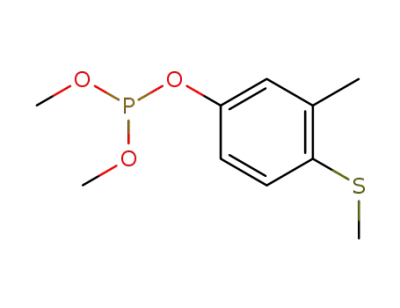
-
154469-89-3
dimethyl-(3-methyl-4-methylthiophenyl)phosphite

-
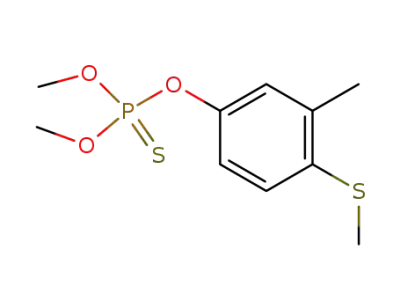
-
55-38-9
fenthion
| Conditions | Yield |
|---|---|
|
With
sulfur;
for 3h;
Ambient temperature;
|
73% |
-
-
55-38-9
fenthion
| Conditions | Yield |
|---|---|
|
|
78% |
|
|
|
|
|
|
|
|
|
|
|
|
|
|
|
|
|
|
|
|
|
|
|
|
|
|
55-38-9 Upstream products
-
154469-89-3
dimethyl-(3-methyl-4-methylthiophenyl)phosphite
55-38-9 Downstream products
-
3761-41-9
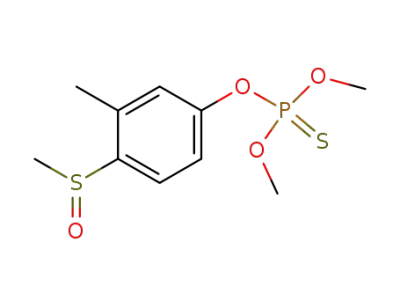
(+)-Fenthion sulfoxide
-
3761-42-0
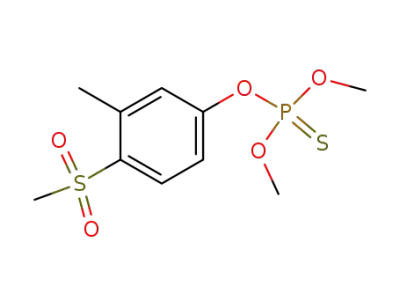
Fenthion sulfone
-
6552-12-1
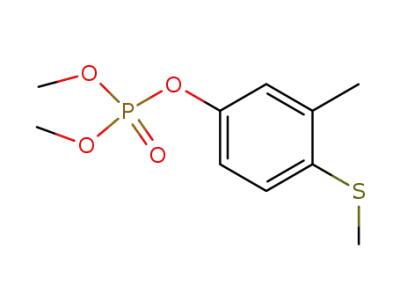
Fenthion oxon
-
6552-13-2
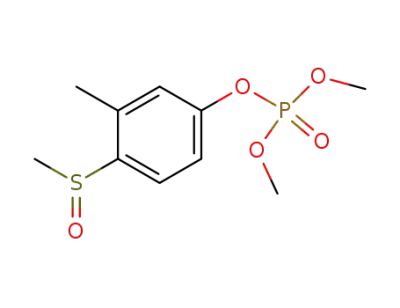
fenthion oxon sulfoxide
Related Products
-
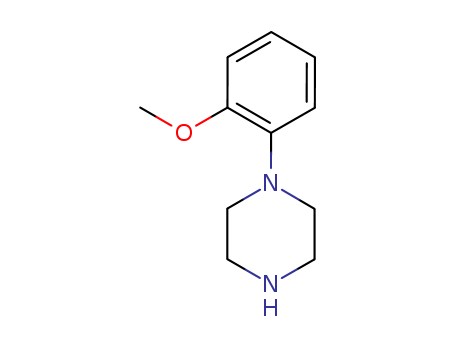 1-(2-Methoxyphenyl)piperazine
CAS:35386-24-4
-
 Metamizole magnesium
CAS:63372-86-1
-
 1-(butylamino)-4-[(3-methylbutyl)amino]anthraquinone
CAS:85409-57-0